Do the roof properly — and be able to prove it.
Most flat roofs in New Zealand don't fail because someone picked the wrong membrane. They fail at a lapped seam, a neglected upstand, or a substrate that was never prepared — details nobody can see once the job is finished. Our mission is to get those details right, and to hand you the documentation that shows we did.
Diagnose before quoting
Flat roofs almost never leak where the water shows inside — it travels along the substrate first. So the wet ceiling is rarely under the failure. We find the actual source before proposing anything, which is why repeat leaks are usually chased rather than diagnosed.
The person who quotes it installs it
Mussi Jorge Rosa runs every job from the first site visit to hand-over. No subcontracted crew who never met you, no salesperson quoting work they won't do. That's the whole reason MRS stays deliberately small.
Specify honestly, even when it costs us the job
We only recommend a re-roof when the membrane is genuinely at end of life. A targeted repair is often enough, and saying so loses us revenue on that visit. We'd rather be the contractor you call again than the one who oversold you once.
Flood-test before we call it finished
A membrane that looks right and a membrane that is watertight are not the same thing. We flood-test before sign-off, because the alternative is finding out during the first serious Auckland downpour.
Prepare the substrate properly
It's the step most failures skip, because nobody sees it once the membrane is down. Preparation is invisible, unglamorous, and the single biggest predictor of whether a roof lasts its warranty.
Leave you the evidence
A Producer Statement (PS3), the manufacturer's system warranty, our workmanship warranty in writing, a maintenance schedule, and photo records of prep, flashings, upstands and flood-test results. If we can't show it, we didn't do it.
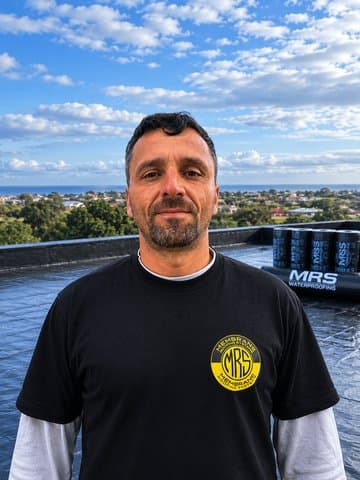
One licensed roofer, accountable for every job
Membrane Roofing Systems is owner-operated by Mussi Jorge Rosa, a Licensed Building Practitioner (Roofing) with 12+ years on membrane roofs across New Zealand. Most of our work is commercial and multi-residential — including schools, hospitals and public buildings — alongside residential flat roofs where the architecture calls for it.
We stay small on purpose. Growing past the point where Mussi can personally stand on every roof would mean breaking the promise this page is built on.
Site visits are free. So is the written quote.
How our approach works in practice
What makes Membrane Roofing Systems different from other roofers?
MRS is owner-operated: Mussi Jorge Rosa, a Licensed Building Practitioner (Roofing), personally runs every job from the first site visit through to flood-test and hand-over. There is no subcontracted crew you never meet and no salesperson quoting work they won't carry out. That limits how much work MRS can take on, which is deliberate.Will you tell me if I don't need a new roof?
Yes. MRS only recommends a re-roof when the membrane is genuinely at end of life — a targeted repair is often enough, and saying so means less revenue on that visit. Because the site visit and written quote are both free, there is no cost to getting an honest second opinion.Why does flood-testing matter?
A membrane that looks right and a membrane that is watertight are not the same thing. Flood-testing before sign-off proves the installation holds water under controlled conditions rather than finding out during the first serious Auckland downpour. Results are photographed and included in the hand-over documentation.What do I actually receive when the job is finished?
A Producer Statement (PS3) for the waterproofing work, the manufacturer's system warranty (20 years for TPO and warm roofs, 15 years for torch-on and liquid), the MRS 5-year workmanship warranty in writing, a maintenance schedule, and photo records of substrate prep, flashings, upstands and flood-test results.Why do flat roofs fail in New Zealand?
Rarely because of the membrane itself. Failures start at details — a poorly lapped seam, a neglected upstand, ponding where the fall is wrong, or a substrate that was never properly prepared. Auckland's driving rain and long damp spells then punish that weak point until it shows inside. Preparation is invisible once the membrane is down, which is exactly why it gets skipped.Do you work outside Auckland?
Auckland and the surrounding region is standard. MRS also takes commercial and multi-residential work across the rest of New Zealand — past projects include Dunedin Public Art Gallery and Otago Boys High School.
Want it done this way on your roof?
Book a free site visit. Mussi inspects it himself and puts a fixed price in writing.